Australia’s Packaging Recycling Reform: What Happens Next?

Australia’s approach to packaging waste and recycling has been the subject of ongoing discussion, with industry, government and consumers continuing to look for more consistent and effective solutions.

Recent developments have raised further questions about the future of packaging reform in Australia, following the Federal Government’s decision not to introduce proposed mandatory packaging standards during its current term.

The proposed reforms were intended to establish national packaging requirements, including minimum recycled-content targets and measures to reduce problematic materials and chemicals in packaging. The reforms followed an agreement between Australian governments in 2023, intended to move away from voluntary approaches and toward more consistent national standards.

For food manufacturers, retailers and packaging suppliers, consistency is particularly important. A broader question is also in discussion on the development of Australia’s domestic recycling industry. Australian recycling facilities are reportedly operating below capacity, while recycled materials can face competition from lower-cost imported plastics.

This creates a difficult cycle, without sufficient demand for recycled materials, investment in recycling infrastructure can become challenging, while without reliable domestic recycling capacity, businesses may find it more difficult to source recycled content.

The Government has cited cost-of-living pressures as a key consideration in its decision not to proceed with the proposed national scheme at this time. However, questions remain around the actual cost impact of mandatory recycled-content requirements.

Industry modelling referenced by the ABC estimated that mandatory recycling standards could add approximately 0.3 cents per packaging item. This discussion extends beyond the immediate cost of packaging. It also includes the longer-term costs associated with waste management, recycling infrastructure, resource recovery and environmental impacts.

Businesses should continue to consider packaging design, recycled content and recyclability outcomes as part of their broader product development and sustainability strategies, rather than waiting for mandatory requirements to be introduced. Our packaging regulatory services can assist businesses with reviewing packaging requirements; obtaining regulatory advice early can help reduce compliance risks and avoid costly packaging changes later.

A Proud Moment for MSAC Solutions

We are incredibly proud to have accepted the Professional Services Award for MSAC Solutions at the 2026 Torquay Business Awards.

This recognition is a wonderful acknowledgement of the professionalism, expertise and hard work of our dedicated team, who provide specialist support to clients across Australia and around the world.

MSAC Solutions began on the Surf Coast, and our local heritage continues to be an important part of who we are. Even our Addis Integrity Intelligence platform takes its name from Point Addis, reflecting the connection between our business and the region where it all began.

While our work now supports global clients, we remain proud of our Surf Coast roots and the community that has been part of our journey.

Receiving this award is a great recognition of what our team has built together and the commitment we bring to everything we do. We would like to thank the Torquay Business Awards for recognising MSAC Solutions, and our incredible team and clients for being part of our continued growth.

A very proud moment for MSAC Solutions and an exciting milestone as we look towards the future.

Annual Common Commencement Date For FSANZ-Initiated Food Labelling Changes

Food Standards Australia New Zealand announced a proposed approach to introducing a single commencement date in a calendar year for businesses to apply labelling changes. This approach will provide businesses an opportunity to consolidate legislative applications on products to reduce disruption in the industry and reduce costs. 

Legislative labelling changes introduced by FSANZ can occur multiple times in a year, prompting businesses to redesign labels and possible reformulations. Once consolidated, the date is intended to limit label design costs and operational disruptions, allowing a reduction in the burden of labelling changes. FSANZ is proposing the 30th of May to be the least disruptive to the food supply chain.  

Protecting health and safety is FSANZ’s priority, with this approach to be rigorously reviewed to assess public health risk and benefits. FSANZ called for submissions from stakeholders to provide information on an appropriate date and approach, potential benefits and concerns, and offer alternative approaches or solutions. Submissions were encouraged to submit evidence, examples and data to facilitate responses. Submissions opened 21st of July 2026 and closed 18th of August 2026.   

From a regulatory perspective, an annual common commencement date for food labelling changes would provide greater regulatory certainty, allowing industry, regulators and enforcement agencies to better plan for implementation while reducing compliance costs. It could also improve consistency across the food supply chain, reduce packaging waste and streamline enforcement.  

However, a fixed commencement date could delay the introduction of important consumer information, such as food safety or allergen labelling changes, and create a large implementation workload for small businesses.  

To be effective, the approach should retain flexibility for urgent public health and safety changes and provide clear guidance on which regulatory amendments are covered, while providing complex transition management support and education across the supply chain to coordinate implementations efficiently. 

MSAC will be keeping a close eye on the outcomes of the submissions and proposals going forward. Following the consultation, a summary report will be published by FSANZ presenting the information and evidence submitted to consider the potential risks and benefits of adopting the change. 

Food Fraud Investigation Highlights Importance of Supply Chain Verification

A recent ABC Four Corners investigation examined the authenticity of our everyday products in the grocery aisle. Independent testing commissioned by the investigation suggested that products labelled as pure ingredients or displayed a specific country of origin were instead found to yield different results.

The findings have raised concerns about the strength of traceability and supplier documentation, particularly around claims made on pack. From a food regulatory compliance perspective, the investigation reinforces the importance of maintaining traceability, supply-chain verification and documentation throughout the supply chain.  

While our labelling system in Australia is regulated by legislation and reputable standards, businesses remain responsible for ensuring that any claims are accurate, substantiated and not misleading. The investigation also highlights the increasing use of scientific authentication techniques as a complementary verification tool alongside documentation and audit processes.

The investigation demonstrates the growing expectation from regulators, retailers and consumers for greater transparency across global food supply chains. Four Corners found the food system is built to protect consumers from unsafe food, checking for contamination rather than fraud. In an increasingly complex global food supply chain, Australia is showing to be falling behind on testing for authenticity on our products on shelves. With limited routine testing to detect substitution, false origin claims and other forms of food fraud can act as a public health risk.

While our borders are working hard to ensure robust testing is compliant with import requirements, with authorities detecting hundreds of non-compliant food products each year, Australia’s regulatory system could be strengthened by requiring routine authenticity testing.

The case serves as a reminder that food integrity extends beyond food safety to include transparency and consumer trust. For food manufacturers, importers and retailers, regular supplier assurance activities, effective traceability systems and periodic verification of high-risk ingredients can help mitigate regulatory and reputational risks. 

MSAC Solutions provides you with services through our data-driven solutions and expert teams to build and optimise your brand’s trust and reputation.

AIFST Annual Convention

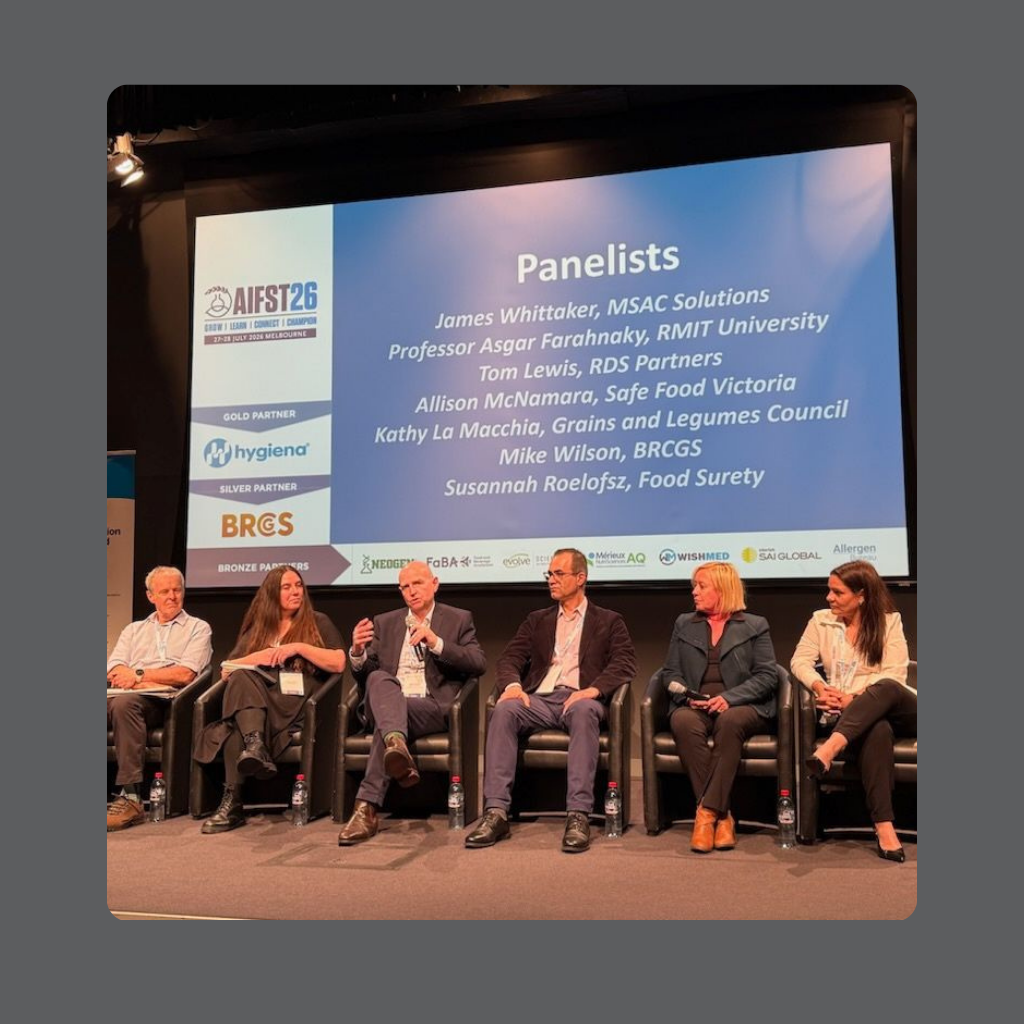
The Australian Institute of Food Science and Technology (AIFST) held its Annual Convention in Melbourne on 27-28 July, bringing together industry, research and academic leaders for two days of learning, discussion and networking.

The convention featured more than 50 speakers covering topics including food safety, nutrition, consumer science, sustainability, food manufacturing and regulatory developments.

A recurring theme throughout the program was artificial intelligence (AI) and its growing application across the food industry. Presentations focused on the challenges facing the food sector and the potential for AI to support improved decision-making, greater efficiency, enhanced product development and innovation. Speakers explored how AI tools can help turn data into actionable insights while complementing the expertise of food science and technology professionals.

Other topics of note included sustainability across food, manufacturing and packaging, the impact of GLP-1 medications on consumer food choices, the role of dietary fibre in health and product innovation, and developments relating to Health Star Ratings.

AIFST26 was co-located with foodpro 2026, Australia’s leading food manufacturing, processing and packaging exhibition, providing attendees with a unique opportunity to explore innovation across the entire food and beverage value chain.

In addition to the formal program, the convention offered valuable opportunities for delegates to connect with peers, exchange ideas and strengthen professional networks across the agrifood sector. There was also panel discussion exploring the role of collaboration in addressing industry challenges and driving innovation across the food sector.

AIFST is Australia’s leading professional body for food science and technology professionals. For more information about AIFST and its activities, visit www.aifst.asn.au.

National Science Week: Science Shaping the Future of Food

August marks National Science Week, Australia’s annual celebration of science, technology and innovation. Held each year, the initiative brings together thousands of events and activities across the country, highlighting the important role science plays in our everyday lives. The week provides an opportunity to recognise the important contribution of science across the food industry and the people who apply scientific knowledge to solve complex challenges.

This year, members of the Australian Institute of Food Science and Technology (AIFST) attended a webinar that explored how science is helping to revolutionise Australia’s food system through an insightful webinar focused on innovation, food safety and sustainability. From the lab to your plate, science underpins every stage of the food system from production and processing through to food safety, labelling and the development of more sustainable products and technologies.

Science underpins food safety you can trust, with scientific research and evidence playing a critical role in identifying emerging food safety risks, strengthening safety controls and supporting regulatory decision-making. The science behind food testing, processing and labelling helps ensure consumers can make informed choices and enjoy food with confidence.

There is a movement where innovation meets sustainability, shown through current advances in artificial intelligence, machine learning and predictive analytics, which are creating new opportunities across the food industry. These technologies can support more efficient processing, improve resource use, reduce waste and help businesses respond to challenges across an increasingly complex food supply chain.

Science and innovation are building the future of food, continuing to shape the future of the agrifood sector, creating new opportunities to improve food security, sustainability, safety and quality. Collaboration between scientists, industry, regulators and technical professionals will be essential in turning emerging technologies and research into practical outcomes.

At MSAC, our roles as food regulatory scientists use technical expertise that is applied every day to assess food and product labelling, specifications and technical requirements against legislative standards and regulations. This work supports businesses in navigating regulatory requirements and helps ensure products meet applicable safety, quality and compliance expectations.

We thank our team for their continued dedication to applying science, technical expertise and regulatory knowledge to deliver positive outcomes for industry, consumers and the broader community.

GS1 Barcodes Transition: What Does This Mean for Your Labelling?

The familiar linear barcode is set to evolve. As part of GS1’s global initiative, the food industry is preparing for the adoption of next-generation 2D barcodes, including QR Codes encoded using GS1 digital linking standards. The transition has significant implications for food manufacturers, retailers and regulatory compliance.

Unlike traditional 1D barcodes that primarily identify a product, GS1-compliant 2D barcodes can store substantially more information within a single code. This enables manufacturers to encode details such as batch numbers and expiry dates while also linking consumers to digital product information including ingredients, allergen declarations, nutrition information, sustainability credentials and recycling guidance.

GS1 2D barcodes offer retailers and manufacturers a multifunctional point-of-sale solution, enabling the delivery of enhanced product information and additional data attributes through a single code. It is important to recognise that mandatory declarations remain, including allergens, ingredient lists, nutrition information panels and date marking, which must continue to appear on the food label unless specific exemptions apply. Digital content should be viewed as complementary rather than a substitute for regulatory labelling requirements.

For businesses considering implementation, it is also important to note that GS1’s 2027 target is an industry ambition rather than a legislative deadline. Current guidance recommends that 2D barcodes be used alongside existing linear barcodes until point-of-sale systems are universally capable of scanning the new formats. Adoption is considered to grow progressively across the Australian retail sector.

As consumer demand for transparency continues to grow, the next-generation barcodes provide an opportunity for food businesses to strengthen product traceability, improve access to information and support transparency. While implementation is not yet mandatory, manufacturers should begin considering how their labelling, packaging and data management systems can support this emerging standard.

While 2D barcodes provide an effective way to deliver additional product information to consumers, businesses should ensure that any information accessed through a digital link is accurate, substantiated and consistent with on-pack labelling. The Australia New Zealand Food Standards Code continues to require mandatory information to appear on the food label.

Contact us today to see how your digital content can serve as a complementary source of information to boost your brand and products.

Climate Change and the Impact on Grocery

The grocery industry is focusing on conversation to build climate resilience across the food supply chain. The Australian food and grocery manufacturing industry is highly exposed to climate-related risks, with agricultural production, water availability and supply chain processes all vulnerable to changing climatic conditions. Recognising these challenges, the Australian Food and Grocery Council (AFGC) supports Australia’s commitment to achieving net zero emissions by 2050 and is working with the industry to improve greenhouse gas reporting and emissions reduction across the value chain.

A company’s supply chain emissions often account for the largest proportion of a food business’s carbon footprint and are becoming increasingly important under Australia’s evolving sustainability reporting requirements. The industry continues to invest in renewable energy, food waste reduction, sustainable packaging and supply chain collaboration to support national emissions reduction targets.

For grocery retailers, climate-related disruptions present challenges across the entire supply chain. Delays in transportation, reduced access to seasonal produce and changing growing conditions require businesses to strengthen supplier relationships, diversify sourcing strategies and improve contingency planning to maintain consistent supply for consumers.

In response, many organisations are investing in more resilient supply chains through supplier diversification, improved forecasting, renewable energy adoption, sustainable packaging initiatives and food waste reduction programs. Digital traceability systems and enhanced data collection are also supporting businesses in managing regulatory obligations while improving visibility across increasingly complex supply networks.

Europe has experienced a record-breaking heatwave, impacting the supply chain, population health, and government pressure. These recent events continue to lead the conversation globally in integrating climate objectives into food regulation. Through sustainable food system agendas, the EU is embedding environmental sustainability alongside food safety, consumer protection and agricultural policy.

These developments are influencing global supply chains, with many multinational food manufacturers aligning sustainability programs across all markets, including Australia. Food businesses should continue preparing for increasing climate-related reporting obligations, enhanced supplier engagement and emissions data collection, stronger expectations around sustainable sourcing and packaging, and greater scrutiny of environmental claims and sustainability credentials.

Businesses that actively strengthen environmental efforts, improve supply chain visibility and invest in credible reporting will be better positioned to meet future regulatory requirements while responding to growing customer and stakeholder expectations. Start a conversation with us today to see how you can lead the way in sustainability for your brand.

Free-Range Claims Under the Spotlight: Ensuring Compliance with Australian Food and Consumer Law

Consumer demand for ethically produced food continues to grow, with “free-range” remaining one of the most influential purchasing claims in the Australian grocery market. However, as consumers increasingly seek transparency around animal welfare, regulators are maintaining a strong focus on ensuring free-range claims accurately reflect production practices.

While the term “free-range” is widely recognised, businesses must ensure that claims made on-pack, online and through advertising are supported by evidence and do not create a misleading overall impression for consumers.

For eggs, the Free-Range labelling requirements that producers must meet include: Hens must have meaningful and regular access to an outdoor range during daylight hours, outdoor stocking densities must not exceed 10,000 hens per hectare, and the outdoor stocking density must be clearly declared on the packaging. This is particularly relevant given recent bird flu outbreaks in Australia, which have increased attention on free-range farming practices and compliance.

These requirements operate alongside the Australian Consumer Law, which prohibits businesses from making false or misleading representations about goods. Importantly, compliance is assessed on the overall impression conveyed to consumers, not simply whether the words “free-range” appear on the label.

Food businesses should consider all elements of product presentation when assessing compliance. Images of hens roaming freely through expansive green paddocks, statements suggesting unrestricted outdoor access, or marketing that overstates animal welfare practices may all contribute to a misleading representation if they do not accurately reflect how the product is produced.

The Australian Competition and Consumer Commission (ACCC) has consistently reinforced that businesses must be able to substantiate not only explicit claims but also any implied messages conveyed through packaging, branding and advertising.

These cases reinforce an important compliance principle for businesses, with documentation and substantiation being essential. Businesses should maintain evidence demonstrating that production practices align with both regulatory requirements and consumer expectations created by marketing claims.

Regular reviews of claims on your pack, marketing materials and substantiation records can help minimise regulatory risk and ensure products remain accurate, transparent and compliant with both food regulatory requirements and Australian Consumer Law. MSAC is facilitated to ensure your claims and documentation are compliant in one place.

FSANZ Seeks Feedback on Australia’s Next Cell-Cultured Food Application

The regulatory landscape for novel foods continues to evolve, with FSANZ recently calling for submissions on Application A1341 Cell-Cultured Duck Biomass. The application proposes an amendment to the Food Standards Code to permit the sale of cell-cultured duck as a novel food, representing another significant milestone in the emerging alternative protein sector.

As with previous cell-cultured food applications, FSANZ has undertaken a comprehensive pre-market safety assessment, evaluating production methods and manufacturing controls, microbiological and chemical safety, nutritional composition, potential risks and dietary impact.

FSANZ’s preliminary assessment has concluded that, when produced in accordance with the proposed specifications, the ingredient does not raise public health or safety concerns and is suitable for inclusion in the Food Standards Code. The application is now open for public consultation before a final decision is made.

The commercial availability of cell-cultured foods in Australia remains limited, with the regulatory pathway becoming increasingly established. Food businesses developing, importing or considering future use of cultivated ingredients should monitor these applications closely, as each approval helps define the regulatory expectations for this emerging category.

Compliance considerations by businesses should ensure they are prepared to demonstrate robust evidence. This is achieved by supporting the safety of the ingredient through comprehensive documentation of manufacturing processes and quality controls, appropriate traceability throughout the production chain, compositional specifications and conditions of use.  

A key regulatory principle is that food labels must not be false, misleading or deceptive. This means businesses will need to ensure that product names and descriptions accurately reflect the nature and production method of cell-cultured foods, enabling consumers to make informed purchasing decisions. This ensures consumers have accurate product descriptions and labelling that meet all applicable regulatory requirements.

FSANZ has included their application and provisions that must be applied. Division 2 of Standard 1.5.4 sets out the following general labelling requirements for cell-cultured foods: Section 1.5.4-5 applies to food for sale that has a cell-cultured food as an ingredient and requires that, for the labelling provisions in Standard 1.2.1, ‘information relating to cell-cultured food’ requires the use of either ‘cell-cultured’ or ‘cell-cultivated’ in conjunction with the name of the ingredient that is a cell-cultured food.

Interest in cultivated proteins continues to grow internationally, with regulators balancing innovation alongside consumer confidence and food safety. As additional applications are assessed, businesses should expect further guidance around regulatory expectations, product naming, labelling and market authorisation processes.

Get in touch with our regulatory team to see what this could mean for your brand and future production.